


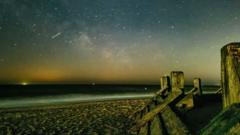
The United Kingdom is preparing for a spectacular celestial display as the Lyrid meteor shower reaches its peak, with forecasts predicting unusually clear skies across much of the nation. This ancient astronomical event, which has been recorded for over 2,700 years, promises excellent viewing opportunities for enthusiasts and casual observers alike, particularly on Wednesday night.
Originating from the debris trail of Comet C/1861 G1 Thatcher, the Lyrids are renowned for producing swift and bright meteors, occasionally leaving glowing dust trails that linger in the atmosphere for several seconds. Experts anticipate that stargazers could witness up to 15 to 20 meteors per hour during the peak viewing window, which extends into the early hours of Thursday morning. The shower’s radiant point appears to emanate from the constellation Lyra, near its brightest star, Vega, though meteors can be seen across various parts of the night sky.
Optimal viewing conditions are expected, with meteorologists forecasting minimal cloud cover, a significant advantage for observing this annual spectacle. To best experience the shower, observers are advised to find a location away from urban light pollution, allow their eyes at least 20 to 30 minutes to adapt to the darkness, and look towards the darkest part of the sky. No special equipment, such as telescopes or binoculars, is required; the Lyrids are best enjoyed with the naked eye. Patience is key, as meteor activity often comes in bursts. This year’s display is particularly favorable due to the concurrent lunar phase, ensuring darker skies unhindered by bright moonlight.