


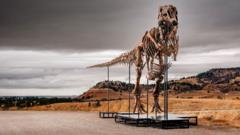
A 67 million-year-old Tyrannosaurus rex fossil is poised to go under the hammer in New York, carrying an estimated pre-sale value of $30 million. This high-profile auction underscores a deepening concern within the scientific community regarding the increasing privatization of significant paleontological discoveries. As exceptionally well-preserved dinosaur remains become highly sought-after commodities for the super-rich, scientists face growing challenges in accessing these invaluable specimens for crucial research and study.
When a major fossil enters private ownership, it often becomes unavailable to paleontologists who rely on such discoveries to advance our understanding of prehistoric life, evolution, and ancient ecosystems. Unlike public museums and academic institutions, which make specimens accessible for continuous analysis, private collections can effectively remove these irreplaceable artifacts from the scientific record. This limits opportunities for researchers to conduct detailed examinations, compare findings with other specimens, and contribute to the collective knowledge base.
Public museums, which traditionally house and display such treasures for educational purposes, frequently find themselves outbid by wealthy individuals in a rapidly inflating market. Consequently, many scientifically vital fossils might never be showcased to the public, studied by experts, or integrated into ongoing research programs, thereby diminishing public education and scientific progress. The soaring prices, driven by demand from affluent collectors, also risk incentivizing unscientific excavation practices, where the commercial value of a fossil might overshadow its scientific context and proper documentation. The upcoming sale of this T-rex highlights the ongoing tension between the commercial market for rare fossils and the imperatives of scientific inquiry and public accessibility.