


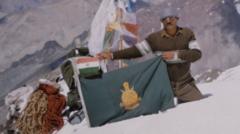
For decades, one of the most sobering sights for climbers ascending Mount Everest has been the body known simply as ‘Green Boots.’ The moniker refers to an Indian climber, Tsewang Paljor, whose remains, identifiable by his distinctive bright green boots, have been a chilling landmark along the North Face route, positioned near a cave at 8,500 meters. For many navigating the arduous climb toward the summit of the world’s highest peak, his presence has served as a poignant, if grim, trail marker.
Paljor was a member of a 1996 Indian expedition that tragically encountered a fierce blizzard. He succumbed to the mountain’s extreme conditions, becoming one of many who have lost their lives in the notorious “death zone” above 8,000 meters. The immense logistical challenges, the perilous conditions, and the exorbitant costs associated with body retrieval at such altitudes have meant that numerous fallen climbers have remained frozen where they perished, their bodies preserved by the sub-zero temperatures and thin air.
However, after approximately three decades, there are now efforts underway that could see Paljor finally brought down from the mountain. This potential repatriation marks a significant shift in the discourse and practical approaches to the sensitive issue of deceased climbers on Everest. The decision to recover ‘Green Boots’ reflects a growing call within the mountaineering community and among ethical bodies to accord greater dignity and respect to those who have sacrificed their lives on the peak.
While many bodies are still scattered across the upper reaches of Everest, the prospect of recovering such a prominent figure as Paljor could set a precedent for future efforts, highlighting a move towards greater accountability and humanity on the world’s most challenging mountain. For Paljor’s family, this potential recovery offers the hope of long-awaited closure after a generation of uncertainty. For the climbing world, it signifies a poignant moment, transforming a macabre landmark into a symbol of dignity and remembrance, finally allowing one of Everest’s most enduring figures to return home.